
Learning human anatomy has evolved far beyond textbooks and static diagrams.
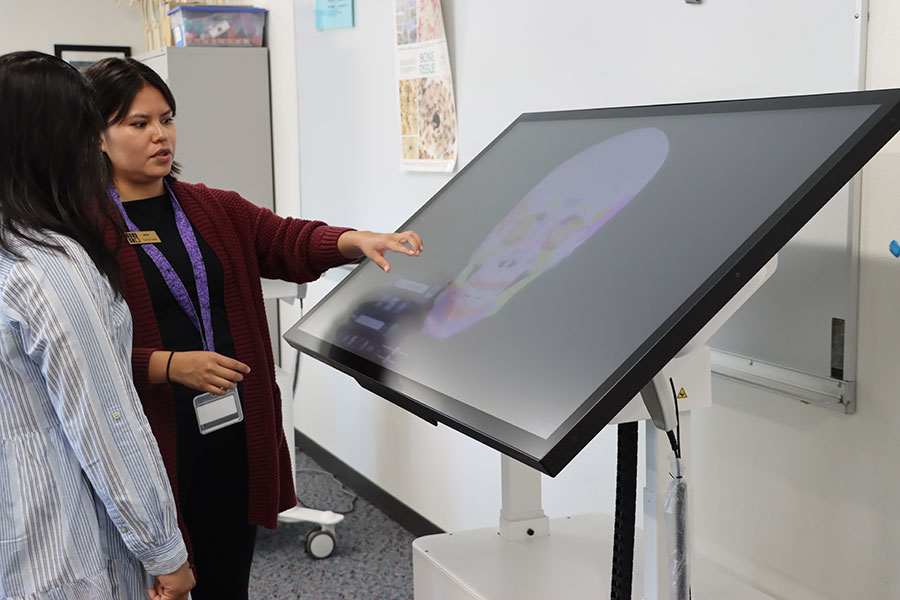
Students are gaining a deeper understanding of the human body through three state-of-the-art Anatomage Tables, interactive 3D anatomy systems that allow them to explore real human anatomy in remarkable detail.
Using digitized human cadavers, the Anatomage Tables provide an immersive learning experience that helps students visualize bones, muscles, organs, nerves and body systems. The technology supports students enrolled in anatomy, physiology and health sciences courses by giving them another powerful tool to reinforce classroom instruction.
Advanced Anatomy Technology Supports Student Success
The tables transform the study of anatomy into an interactive experience. Students can rotate the human body, isolate individual organs and body systems, examine structures layer by layer and explore anatomical relationships with precision.
According to Veronica Evans, Dean of the School of Math, Science and Engineering, the technology provides students with another pathway to understanding some of the college's most challenging coursework.
"The Anatomage Tables give our students another way to visualize and understand anatomy," Evans said. "Anatomy and physiology can be some of our most challenging courses, and we're focused on providing tools that help students succeed through interactive learning."
Each Anatomage Table represents an investment of approximately $80,000 in student learning and academic success. The college acquired its first table through funding from the Native American Center grant for STEM. Two additional tables were purchased with support from San Juan Regional Medical Center (SJRMC) as part of the expansion of SJC’s nursing program.
Investing in the Future of Healthcare
The partnership between San Juan College and San Juan Regional Medical Center reflects a shared commitment to preparing the next generation of healthcare professionals.
"We know that investing in the next generation of nurses is one of the most important ways we can strengthen healthcare in our region," said Jason Rounds, President and CEO of San Juan Regional Medical Center. "San Juan Regional Medical Center is proud to partner with San Juan College to expand its nursing program and provide the tools needed to help prepare the next generation of highly trained nurses to care for our community for years to come."
The Anatomage Tables enhance that mission by providing students with access to advanced medical technology they may encounter throughout their healthcare careers.
A Powerful Resource Beyond the Classroom
Although the tables are not currently integrated into the formal curriculum, they are available as supplemental learning resources for students studying anatomy, physiology and other health sciences disciplines.
Jessica Cambridge, supplemental instructor for Anatomy and Physiology, says the technology gives students valuable opportunities to strengthen their understanding outside scheduled class time.
"It provides students with an opportunity to reinforce what they're learning outside the classroom," Cambridge said. "One thing I really like is the repetition the interactive case studies provide. That's especially valuable for students in the fall semester when they're learning so much new terminology."
The ability to revisit concepts, repeat exercises and explore anatomy independently helps students build confidence as they prepare for exams and future healthcare careers.
Interactive Learning Makes Anatomy Easier to Understand
Students are already experiencing the benefits of learning with Anatomage technology.
"I'm a visual learner, so this technology has been super helpful to me," said one nursing student enrolled in Anatomy and Physiology. "I can see what I'm looking for in the body on a much larger interactive scale."
Rather than replacing traditional instruction, the Anatomage Tables complement lectures, textbooks and laboratory activities by giving students another way to engage with complex material.
Whether reviewing anatomical terminology, studying body systems or exploring the relationships between organs and tissues, students can learn at their own pace while developing a stronger understanding of human anatomy.

-(1).jpg)